Feardom: How Politicians Exploit Your Emotions and What You Can Do to Stop Them by Connor Boyack
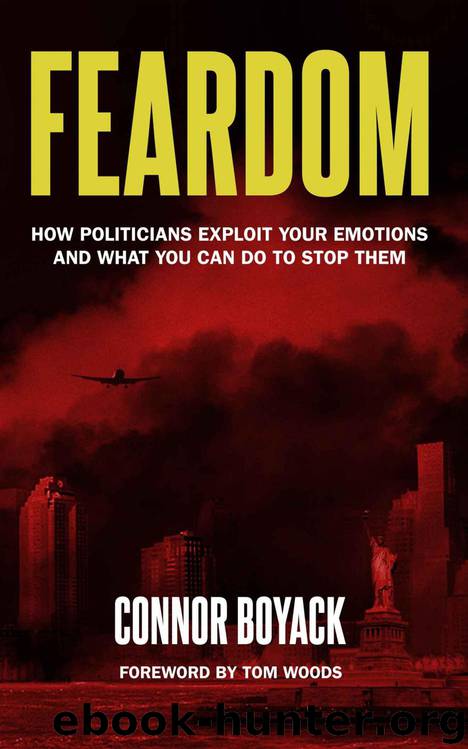
Author:Connor Boyack [Boyack, Connor]
Language: eng
Format: epub
Publisher: Libertas Press
Published: 0101-01-01T00:00:00+00:00
PROPAGANDA

In December 2010, 26-year-old Mohamed Bouazizi was selling produce at a roadside stand in a rural town in Tunisia, where he had worked for seven years, providing for a widowed mother and six siblings as the family’s sole breadwinner. Due to his lack of a permit, a policewoman confiscated his cart and produce, and when Bouazizi attempted to pay the fine, the policewoman insulted his deceased father and allegedly slapped him. Afterward, Bouazizi visited the provincial headquarters to file a complaint but was turned away. Within an hour of the initial confrontation at the roadside stand, he proceeded to drench himself with a flammable liquid and set himself on fire. This act of desperation sparked a firestorm of protests from sympathetic Tunisians, catalyzing civil unrest and opposition that had been bubbling beneath the surface for years.
Tunisia’s president had been in power for 23 years, reigning over a government riddled with corruption and crackdowns on dissenters and political opponents. Motivated by these and other issues, such as high unemployment, inflated food prices, and poor living conditions, citizens poured into the streets en masse—activists, students, professors, lawyers, and a variety of other groups—to call for the president’s resignation. A popular chant was “We are not afraid, we are not afraid, we are afraid only of God.”25 Four weeks after Bouazizi’s self-immolation sparked a countrywide revolt, the president stepped down and fled to Saudi Arabia. Revolts continued, leading the way towards a government shake-up though progress has been slow, and most of the problems that led to revolution remain.
The success of the Tunisian uprising inspired activists and discontented citizens in neighboring nations, resulting in a wave of opposition throughout almost all the Arab countries—the “Arab Spring.” Just one month after Tunisia’s president was toppled, Egyptian president Hosni Mubarak resigned, ending his brutal 30-year presidency. Major protests then broke out in Libya and turned into a full-blown civil war, resulting in the downfall of Muammar Gaddafi’s repressive 42-year regime a few months later. Several other heads of state stepped down from power or announced they would not seek re-election, offering a glimpse of hope to those who for years—or their entire lives, in many cases—had been living under oppressive political establishments.
There are some who might look at these dethroned despots and consider them amateurs for having carelessly created circumstances that led to their loss of political power. Thomas Jefferson had observed timid men who preferred not confrontational despotism, but calm despotism—a result that requires precision and careful execution. The despotism with which we generally associate the term enrages those who clearly see the injury being caused them, whether it be a friend brutally punished by the police, a relative tortured for his political opposition, or a job lost due to harsh economic controls. “I consider that in no government power can be abused long,” wrote Samuel Johnson, the famous 18th-century British literary figure. “Mankind will not bear it. If a sovereign oppresses his people to a great degree, they will rise and cut off his head.
Download
This site does not store any files on its server. We only index and link to content provided by other sites. Please contact the content providers to delete copyright contents if any and email us, we'll remove relevant links or contents immediately.
The Secret History by Donna Tartt(19032)
The Social Justice Warrior Handbook by Lisa De Pasquale(12182)
Thirteen Reasons Why by Jay Asher(8884)
This Is How You Lose Her by Junot Diaz(6872)
Weapons of Math Destruction by Cathy O'Neil(6261)
Zero to One by Peter Thiel(5782)
Beartown by Fredrik Backman(5734)
The Myth of the Strong Leader by Archie Brown(5491)
The Fire Next Time by James Baldwin(5424)
How Democracies Die by Steven Levitsky & Daniel Ziblatt(5211)
Promise Me, Dad by Joe Biden(5141)
Stone's Rules by Roger Stone(5079)
A Higher Loyalty: Truth, Lies, and Leadership by James Comey(4946)
100 Deadly Skills by Clint Emerson(4911)
Rise and Kill First by Ronen Bergman(4776)
Secrecy World by Jake Bernstein(4738)
The David Icke Guide to the Global Conspiracy (and how to end it) by David Icke(4697)
The Farm by Tom Rob Smith(4500)
The Doomsday Machine by Daniel Ellsberg(4481)
